If you should know the answer to these questions about MPLS, but don’t, this is the course for you:

Course 110 IP, VoIP and MPLS for the
Non-Engineering Professional
is the “next” course in our Core Training series, covering only newer technologies: virtually all aspects of IP networks and services.

Designed for non-engineers, this training course will give you the solid, vendor-independent foundation knowledge necessary to deal with IP telecom network projects and IP voice and data applications with confidence. 

If you want to know the answers to these questions, or you should know the answer to these questions, but don’t, this is the course for you: 
 
When an organization like TELUS says it “has an MPLS network” and sells “MPLS services”,
- What exactly does that mean?
- Just what is an MPLS service anyway? What does it do? Who uses it? What for?
- Can you tell me two different ways MPLS service is different than Internet service?
- What benefit does that bring to the customer?
- Does it cost more? Better yet, is it costed the same way as Internet service?
- How do you connect to MPLS service?
- What is the technology and business environment for MPLS service going to in 2015?
 
I think you’ll agree that knowledge set is career-enhancing knowledge. We often tell people “if you want a guaranteed job, be an expert in MPLS”. Here’s a great place to start! 

And this is only one part of this intensive, three-day leadership and technology development course!
You will also learn the workings of SIP and softswitches; the nuts-and-bolts of packetized voice and its protocols; Layer 2, VLANs and 10 Mb/s - 40 Gb/s Ethernet services; IP routing; the ISP business and more.

In three days, you’ll get up to speed, demystify jargon and buzzwords, fill the gaps, understand the technologies, the underlying ideas and how it all fits together… knowledge you can’t get from trade magazines or salespeople. 

This investment will be repaid many times over, eliminating frustration at buzzword-filled meetings, increasing your efficiency, and helping ensure you make the right choices. IP, VoIP and MPLS is an essential knowledge set going forward in telecommunications. 

This professional training course will give you the solid, vendor-independent foundation necessary to deal with IP telecom network projects and IP voice and data applications with confidence. 

Get this career-enhancing knowledge today! 

BOOT CAMP: Washington DC week of August 26. Carpe Diem!

telecommunications training BOOT CAMP
consists of two courses back-to-back to make a full week:
Telecom, Datacom and Networking for Non-Engineers (Course 101) and Understanding Voice over IP (Course 130).
You get a 15% discount on both courses, saving $350.
how to get the discount


This is an easy sell with management.
Your increased efficiency, productivity and informed decision-making will repay the cost of the training many times over. Plus, surveys show that managers prefer late August as the best time of year for training: vacations are over and new projects are not underway, so it’s an ideal time to slot in training.
 
Seize this opportunity to really get up to speed and fill in the gaps.
You’ll have an advantage over the competition with this career-enhancing knowledge of telecom, datacom, networking and VoIP. You’ll be a lot more effective and a lot less frustrated, understanding the ensemble of communications technologies, the jargon, buzzwords and how it all works together. register now


Attend Course 110 May 18-20 and get 50% off Course 101 June 1-3. Transferable!

telecommunications training Course 110: IP, VoIP and MPLS for Non-Engineers is the second stage of our “core training”, covering virtually all aspects of IP networks, Voice over IP, VPNs, IP security, SIP, MPLS, carrier services, connecting to carriers and more. This totally up-to-date course will give you the solid, vendor-independent foundation knowledge necessary to deal with IP network projects and IP voice and data applications with confidence.

Blowout Special!
Attend Course 110 in Santa Clara May 18-20 and
get Course 101 in Santa Clara June 1-3 at half price! A $695 value!
Even better: it’s transferable.
We’ll give you a coupon anyone can use!
 
Getting up to speed on IP is essential career- and productivity-enhancing knowledge that you can’t afford to be without if you want to go forward in the telecom business… and this one-time offer makes it easier than ever to benefit from Teracom’s world-renowned training. Hurry! This offer ends very soon and will not be repeated.
 

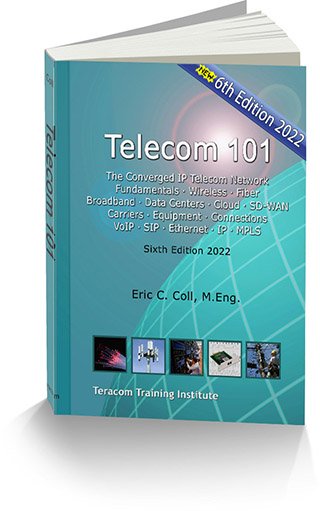
Free Telecom 101 Textbook!

Course 101: Telecom, Datacom and Networking for Non-Engineers is our “core training” - an intensive three-day course designed for non-engineering professionals, to get you up to speed on virtually all aspects of telecom, datacom and networking, from fundamentals and jargon to the latest technologies. The content, its order, timing and pacing have been tuned and refined over the course of sixteen years – and we constantly update it.

Special!

Attend Course 101 in Santa Clara June 1-3 and get a Telecom 101 textbook free!
Act now, as this is a once-only offer that will not be repeated this season.
 
Thousands of people from organizations including Cisco, Intel and Microsoft, the CIA, IRS, FAA, and FBI, all branches of US Armed Forces, Verizon, AT&T, TELUS and Qwest, Wells Fargo, Bank of America, TD Bank, Oneida Tableware, the Portland Trailblazers and hundreds of others who needed to be more effective in understanding and dealing with telecom and networking technology have benefited from this course.
 
Our goal is to bust the buzzwords, demystify the jargon and instill structured understanding… in plain English. Register today! You will receive your free textbook at the course. This is in addition to the 384-page course materials.
 

How ISPs connect to the Internet: peering vs. transit

This discussion is covered in Course 101, Chapter 16 “Understanding the Internet”,
and in more depth in Course 110, Chapter 16 “IP as a Business: Carrier Networks, Competition and Interconnect”

Originally, the only way to get on to the Internet was from a terminal connected to a computer at a university or research institute. The Internet was mostly circuits paid for by the taxpayers via the National Science Foundation. Today, commercial Internet access providers, called Internet Service Providers (ISPs) provide the capability for anyone to access and communicate over on the Internet. These ISPs are for the most part business units of facilities-based carriers, i.e. telephone companies and cable companies.

Such service providers have physical access circuits and circuit-terminating equipment on the customer side, plus routers, security and access control equipment to manage customer traffic. This is often organized with data centers in cities or regions, which are interconnected. This ensemble of interconnected routers controlled by an ISP is called an Autonomous System (AS).

The Internet is a vast, unregulated collection of interconnected Autonomous Systems. The connections between ASs are not specified by a central authority or world government, but are implemented on a case-by-case basis by the operators of an AS for business reasons. The Internet is not free. It is not a public utility. It is a business.

ISPs operating ASs will connect to competitors and content providers like Google to exchange traffic terminating on each other’s network (called peering), and will connect to larger organizations who will assure delivery of packets to other destinations (transit). The networks are physically connected at Internet Exchange (IX) centers such as Equinix Chicago at 350 E Cermak. These are buildings with equipment implementing network interconnection operated by a neutral third party. The ASs are responsible for paying for connectivity to the IX.

Course 101, page 16.09: Internet Service Providers

Internet Service Providers

Peering is settlement-free, i.e. no money is exchanged. Transit is a commercial service that costs money. Larger ISPs charge smaller ISPs for transit services. The largest networks are sometimes called Tier-1 service providers… but “Tier-1” is not an officially defined term. Some claim that it means a network “close to the center of the Internet” or a network that does not pay for transit. However, there is no “center” to the Internet, and virtually all networks employ a mix of peering and transit agreements to connect to other networks… and the nature of such connections is non-disclosed confidential business information. A “Tier-1 network” might best be thought of as one operated by a very big facilities-based carrier that has presence in most or all IXs and sells transit services to smaller networks and ISPs.

The ISPs build the access network and peering or transit connections to other networks, then charge the users for access. It’s a pyramid scheme. The end users end up paying for all.

In addition to access services, the ISP usually provides a Web server to host your website, a Domain Name Server, and an e-mail server.
Back in the Flintstones era when dial-up Internet access was first available, telcos were a bit slow to react, so for a while, companies like Netcom, MindSpring, Portal, Pipeline, iStar and others had their day in the sun. These organizations were resellers, leasing circuits from a carrier and reselling them to users under per-minute or per-month billing plans.

The carriers eventually began competing with resellers, who for the most part went out of business, selling their customers to the carriers. For example, Netcom is now part of Earthlink, which is majority owned by Sprint. AOL and MSN are the biggest remaining reseller-type ISPs. For the most part, it is business units of the companies that own the cables coming into your home: the LEC and the cable TV company that are the dominant ISPs today.

If you do choose to use a reseller-type ISP, particularly for a business or organization, questions regarding customer service, capacity and availability should be asked. Another is redundancy - do they have a single point of failure? Do they have multiple connections to different Tier-1 providers? What capacity are those connections?

This discussion is covered in Course 101, Chapter 16 “Understanding the Internet”,
and in more depth in Course 110, Chapter 16 “IP as a Business: Carrier Networks, Competition and Interconnect”

The Mature Competitive Environment: Regional Rings and MANs

Competition today means much more than the 1984 idea of LECs, competitive IXCs and switched access charges or subcontracted dedicated access lines. Competition today includes competitors providing various services to residences and business customers using a mix of switched access, subcontracted dedicated access, plus colocation and bypass on the “last mile”. Read more

4G Cellular, OFDM and LTE - the “GSM vs. CDMA” Standards War Ends!

This tutorial is part of the most recent update to Course 101, Chapter 6, October 2008.

After more than 20 years, it appears that an almost universally-accepted standard for mobile radio may finally be implemented, bringing to an end the standards war between carriers that deployed TDMA/GSM for second generation and carriers that deployed CDMA for second generation. Those two factions continued the standards war for the third generation (UMTS and 1X respectively); but now carriers from both of the factions are supporting the GSM/UMTS faction’s Third Generation Partnership Project (3GPP) release 8, known as Universal Terrestrial Radio Access Network Long Term Evolution (LTE). Read more

Soft Switches

The term soft switch is not defined in a standard… meaning that marketing departments at different equipment and software manufacturers use the same term to describe different things.

A switch, in its simplest form, is a device that causes communications to happen from one point to one other particular point, often when there are multiple “other” points to choose from.

A traditional Central Office (CO) telephone switch might be called a “hard” switch, since it has physical line cards that terminate loops. The switching software running on the computer which is the CO switch directs traffic between a line card and a trunk or between two line cards during a phone call.

The term soft switch is used to mean a computer running switching software that does not have telephone line cards – the communications are instead directed to the correct destination by routers routing packets, a software function.

softswitch diagram

Read more

Course 101 certification exam (auto-scoring) free sample

We’ve posted a new free online resource: a portion of the
Course 101 online certification exam.  
To access this or any of our vast selection of free samples,
you may be asked to sign in or sign up for myTeracom. 
It’s free, easy, secure and confidential.

It gives your score automatically! 
This sample certification exam is part of Teracom’s quality all-inclusive training
- along with the course pages previews and/or DVD-video and CBT previews, 
   it is a good way to assess the level and quality of Teracom Training
- plus, assess your current knowledge level to help you decide you do need training!

Check it out!

New schedule - Spring 2009

We are finalizing the new schedule for Spring 2009.

Check out the new sessions scheduled so far:
 Course 101: Telecom, Datacom and Networking for Non-Engineers
 Course 130: Understanding Voice over IP
 BOOT CAMP: Course 101+130 together - save 30%
 Course 110: Understanding IP Telecom: IP, VoIP and MPLS for Non-Engineers

Don’t miss Course 101 and 130 together in TRINIDAD being held in conjunction with
CANTO, the Carribean Association of National Telecommunications Organizations 


Next Page →